A blocked nose after the pool: 74% of swimmers, chloramines and the trap of decongestant drops
The culprit is not chlorine but what chlorine turns into when it meets sweat and urine. 74% of swimmers have rhinitis symptoms against 40% in controls — and two weeks out of the pool clear them. Meanwhile the most popular “treatment” only makes things worse.
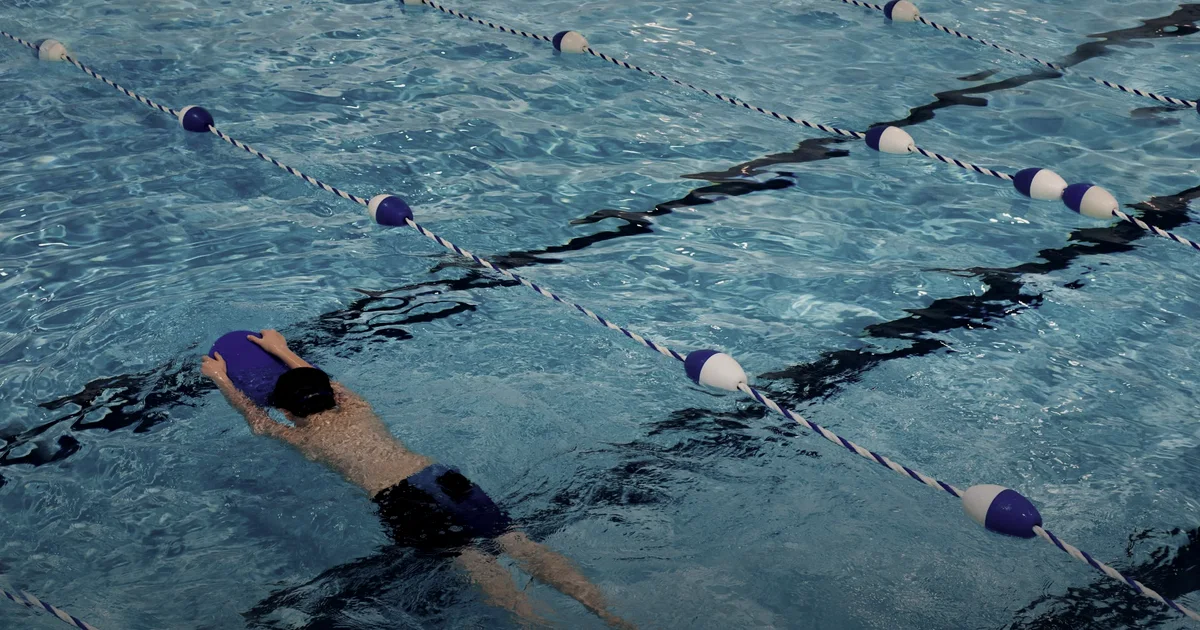
The scenario is familiar to anyone who swims year-round: after training the nose blocks up, a runny nose starts, in a day or two it lets go — and back to the pool. What usually follows is one of two moves: nose drops, or the thought “maybe I should give up swimming”.
Let us unpack what lies behind this, because the mechanism here is not obvious and the most popular solution is the worst one available.
Chlorine is not the culprit
Free chlorine in the water is a mediocre irritant in itself. The problem is created by chloramines — the products of its reaction with the nitrogen-containing organic matter that the swimmers themselves bring into the water: sweat, urea, shed skin cells, cosmetics.
The key compound is trichloramine (NCl₃), also known as nitrogen trichloride. It has two unpleasant properties. It is volatile, so it builds up not in the water but in the layer of air directly above its surface — exactly where a swimmer takes a breath. And it is a potent respiratory irritant: it disrupts the tight junctions between epithelial cells, increases the epithelium's permeability, and triggers oxidative stress and an inflammatory cascade.
The WHO recommends keeping it in pool air no higher than 0.5 mg/m³.
Which, incidentally, leads to a counter-intuitive conclusion that swimming chats state correctly: a strong “smell of chlorine” is a sign of dirty water, not clean water. What you can smell is precisely the chloramines, that is, chlorine that has already done its work. A properly maintained pool should have no pronounced smell.
How many people this is
A study by Bougault et al. (Clinical & Experimental Allergy, 2010) compared 39 high-level swimmers with 30 controls during a period of intensive training:
- rhinitis symptoms — in 74% of swimmers against 40% in controls (p < 0.01);
- quality-of-life score for nasal symptoms — 27.3 ± 28.5 against 9.5 ± 12.7 (p < 0.005).
And the most informative part: after at least two weeks without swimming, the swimmers' symptoms and quality of life came level with the controls. That is a strong argument that the cause is the exposure itself rather than a seasonal allergy, which would not have gone anywhere.
Pooled data make swimmers the athletic group most affected by rhinitis: from 40% to 74% in different samples. In the most heavily exposed Norwegian swimmers the prevalence of asthma reached 36%.
The rhinitis is more often non-allergic in character — cytologically, neutrophilic inflammation predominates, with congestion the dominant complaint. That is why antihistamines so often fail: they are designed for a different mechanism. What people in chats describe as “the antihistamines didn't help” is not an individual quirk but a regularity.
The trap that makes this worth reading to the end
The review in Applied Sciences (Fritz et al., 2026) devotes a separate section to the behavioural side of the problem, and it matters more than the biochemistry.
Congestion → decongestant drops (xylometazoline, oxymetazoline) → instant relief → repeat use. After a few days of regular use, rhinitis medicamentosa develops: rebound congestion, which requires the same drops to relieve it, and the circle closes. The pool exposure has not gone anywhere, and now a second, iatrogenic source of swelling has been added to it.
The authors point to one more specifically sporting reason why athletes reach for vasoconstrictors in particular: uncertainty about the anti-doping status of medications. It is easier to buy over-the-counter drops than to work out what is allowed. Note that topical decongestants are not on the WADA prohibited list, whereas systemic pseudoephedrine has a urinary concentration threshold — so the logic “drops are safer” is right in exactly the opposite way to how it is usually applied.
The review separately notes that the stability of nasal breathing affects more than comfort: it is linked to sleep quality, perception of effort and training consistency. There is no direct evidence of an effect on performance, and the authors emphasise this.
What does work
A nose clip. In cytological studies of non-allergic rhinitis in swimmers, wearing a clip over 30 days of training significantly reduced both the symptoms and the objective signs of rhinitis. The mechanism is straightforward: you simply do not pass contaminated air and water through the nasal mucosa. The price is having to rebuild your breathing, which takes a few sessions.
Saline nasal rinsing straight after training. It mechanically removes the deposited chloramines before they have had time to generate inflammation. Cheap, safe, done in the shower.
Topical corticosteroids (mometasone, fluticasone) are what is indicated for persistent rhinitis, unlike vasoconstrictors. They do not work immediately: a course, not a one-off application, and a doctor prescribes them. Note that this is a fundamentally different class from the “decongestant” drops in the adverts.
Choice of pool. The concentration of trichloramine in the air depends on ventilation and the water turnover regime more than on anything else. An outdoor or well-ventilated pool is not superstition but a working solution. If the hall smells noticeably from tens of metres away, that is concrete information about the quality of the air you will be breathing for the next hour and a half.
Honest limitations
The 2026 review is narrative, not systematic. The authors write plainly that the available data are predominantly mechanistic and observational, and that the links proposed should be treated as hypothesis-generating rather than as proof of an effect on sporting performance.
The samples in the primary studies are small — dozens of people, often high-level athletes with training volumes an amateur does not have.
The causal link “chloramines → rhinitis” has not been tested directly in an RCT and, for ethical reasons, is unlikely ever to be. The argument rests on the dose dependence seen in pool workers and on the disappearance of symptoms after a break.
The asthma data in swimmers relate to the elite with years of high volume; they cannot be transferred to three sessions a week.
What to do
- Do not use decongestant drops for more than 3–5 days in a row. This is the one item on the list where the mistake creates a new illness on top of the old one.
- Rinse your nose with saline straight after the pool — the cheapest measure with an understandable mechanism.
- Try a nose clip if the symptoms are regular. It is the only intervention with direct data on reducing the signs of rhinitis in swimmers.
- Judge a pool by its smell and its ventilation. A sharp smell is a marker of chloramines, that is, of exactly what is harming you.
- With persistent congestion, go to an ENT specialist rather than picking out drops. Non-allergic neutrophilic rhinitis is not treated the same way as the allergic kind, and antihistamines are predictably useless here.
- If a cough and shortness of breath appear in the water — that is now a question about the lower airways, and it needs to be checked separately.
The bottom line
- The irritant is not chlorine but chloramines, above all trichloramine, which builds up in the layer of air above the water; the WHO recommendation is up to 0.5 mg/m³.
- A strong smell of chlorine means dirty water, not clean.
- Rhinitis symptoms — in 74% of swimmers against 40% of controls; after two weeks without swimming the difference disappears.
- The rhinitis is more often non-allergic and neutrophilic — which is why antihistamines usually do not help.
- Decongestant drops used regularly produce rhinitis medicamentosa with rebound congestion.
- A nose clip for 30 days significantly reduced the symptoms and the objective signs of rhinitis.
- The 2026 review is narrative; the link to performance remains a hypothesis rather than an established fact.
Sources: Fritz B., Stubnya M., Fritz P. “Upper Airway Dysfunction as a Modifiable Determinant of Physical Function in Aquatic Athletes: Irritant Rhinitis and Decongestant Overuse”. Applied Sciences, 2026;16(8):3821. DOI: 10.3390/app16083821 · Bougault V., Turmel J., Boulet L.P. “Effect of intense swimming training on rhinitis in high-level competitive swimmers”. Clinical & Experimental Allergy, 2010;40(8):1238–1246. DOI: 10.1111/j.1365-2222.2010.03551.x · Gelardi M. et al., non-allergic rhinitis in swimmers, cytological aspects · WHO Guidelines for Safe Recreational Water Environments, volume 2