Type 1 Diabetes and Endurance: How to Train Without Fearing Hypoglycemia
Aerobic work drives glucose down, while intervals can push it up — and that changes the entire tactic. We break down target ranges, insulin adjustments and the 90-minute rule you should be discussing with your doctor.
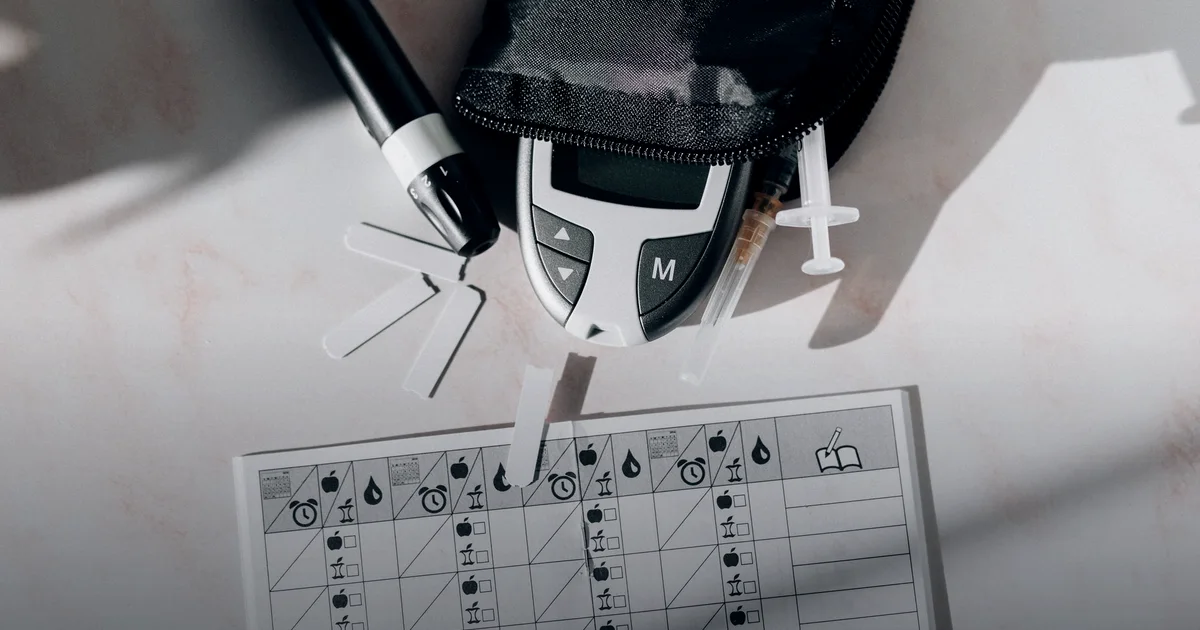
The main reason people with type 1 diabetes avoid physical activity is fear of hypoglycemia. That is not a guess but a conclusion from the review literature: it is named as the single most common barrier. And the fear is well founded — severe episodes, especially nocturnal ones, are linked to a substantial rise in mortality. But the conclusion to draw is not "don't train", it is "understand the mechanics". And endurance has its own mechanics, different from what happens during strength work.
This material is educational and does not replace medical advice. Any changes to insulin doses, target ranges and nutrition strategies should be discussed with your treating endocrinologist — the figures given here are meant to make that conversation concrete, not to be applied on your own.
Why aerobic work and intervals behave differently
This is the key to everything else. Prolonged aerobic work produces a more pronounced initial drop in glucose, but the hypoglycemic effect itself lasts somewhat less time. Strength work, on the contrary, usually causes an acute rise in glucose followed by increased insulin sensitivity, and the swings after it are generally smaller.
A separate case is high-intensity intervals in the fasted state: the counter-regulatory response (a surge of catecholamines and glucagon) can hold glucose steady or even push it up.
Hence the different starting ranges cited in the literature:
- before prolonged aerobic work — 7.0–10.0 mmol/L;
- before intervals or strength work — 5.0–7.0 mmol/L;
- outside of exercise — 4.0–7.0 mmol/L;
- a moderate excess during work (7.1–13.9 mmol/L) is considered acceptable.
The logic is simple: the larger the expected drop, the higher the starting point.
Insulin: how far in advance and by how much
Everything here hinges on "insulin on board" — the part of the previous dose that has not yet done its work. That is exactly what limits spontaneous training: heading out for a long run right after a bolus is a bad idea.
The general principles described in the literature:
- Multiple daily injections: reduce the rapid-acting mealtime bolus taken 1–3 hours before exercise by 25–75%.
- Pump: a temporary basal rate reduction of 50–80%, 60–90 minutes before the start.
- Automated insulin delivery systems: switch on "activity mode" 1–2 hours in advance.
- The 90-minute rule: if training starts within 90 minutes of an insulin injection, the dose has to be adjusted in advance, not after the fact.
Meaningful protection from hypoglycemia is achieved when the basal reduction starts roughly 90–120 minutes before the start — especially for morning fasted sessions.
Nutrition around training
- 1–4 hours before: 1–4 g of carbohydrate per kg of body weight.
- During work lasting more than an hour: 30–60 g of carbohydrate per hour. Note that this is noticeably more modest than the current 90–120 g/h for athletes without diabetes — here carbohydrates also serve to stabilize glucose, not just to fuel.
- After: 1–1.2 g/kg in the first 30 minutes, aiming at the first two hours of recovery.
- Overnight protection: a curious finding — taking about 50 g of protein after moderate exercise raised glucagon, GLP-1 and GIP levels overnight and reduced the need for exogenous glucose to maintain normoglycemia compared with water.
What happens after the finish
The most underrated part. Increased insulin sensitivity persists into the next day, and the effect of exercise on glucose metabolism can be traced for up to 48 hours. In practice this means the risk does not end with the training session:
- nocturnal hypoglycemia is a separate risk window after long work;
- doses and nutrition the next day may also need adjusting;
- monitoring should be extended, not wrapped up right after the shower.
On monitoring: during exercise the literature recommends checking glucose every 30 minutes. Continuous glucose monitoring (CGM) helps a great deal here, but with two caveats — sensors have a lag when glucose changes rapidly, and calibration is best done at a calm moment: in the morning, with minimal insulin on board, without food or exercise and with a flat trend arrow.
Key points
- Aerobic work drives glucose down harder, while strength work and intervals can push it up — the tactics differ.
- Starting targets: 7.0–10.0 mmol/L before prolonged aerobic work, 5.0–7.0 before intervals and strength work.
- Insulin: the bolus 1–3 hours before exercise is reduced by 25–75%, pump basal by 50–80%, 60–90 minutes in advance.
- The 90-minute rule: training soon after an injection requires the dose to be adjusted beforehand.
- Carbohydrates during work — 30–60 g/h, after — 1–1.2 g/kg in the first half hour.
- The risk does not end at the finish: insulin sensitivity persists into the next day, the effect can be traced for up to 48 hours, and nocturnal hypoglycemia is a separate window.
- CGM is useful, but remember the sensor lag; check glucose every 30 minutes during exercise.
- All these figures are material for a conversation with your endocrinologist, not instructions for self-management.
Sources: “Nutritional considerations for athletes with diabetes: optimizing performance and glycemic control”, Frontiers in Nutrition, 2026. https://doi.org/10.3389/fnut.2026.1737219. “Post-exercise recovery for the endurance athlete with type 1 diabetes: a consensus statement”, The Lancet Diabetes & Endocrinology, 2021. https://pubmed.ncbi.nlm.nih.gov/33864810/. “Exercise management in type 1 diabetes: a consensus statement”, The Lancet Diabetes & Endocrinology, 2017. https://doi.org/10.1016/S2213-8587(17)30014-1