Exercise-induced bronchoconstriction: when “I never got going” means narrowed airways
In endurance athletes, airway narrowing during exercise is many times more common than in the general population, and diagnosis “by feel” barely works. Here is who it affects and why an objective test is needed.
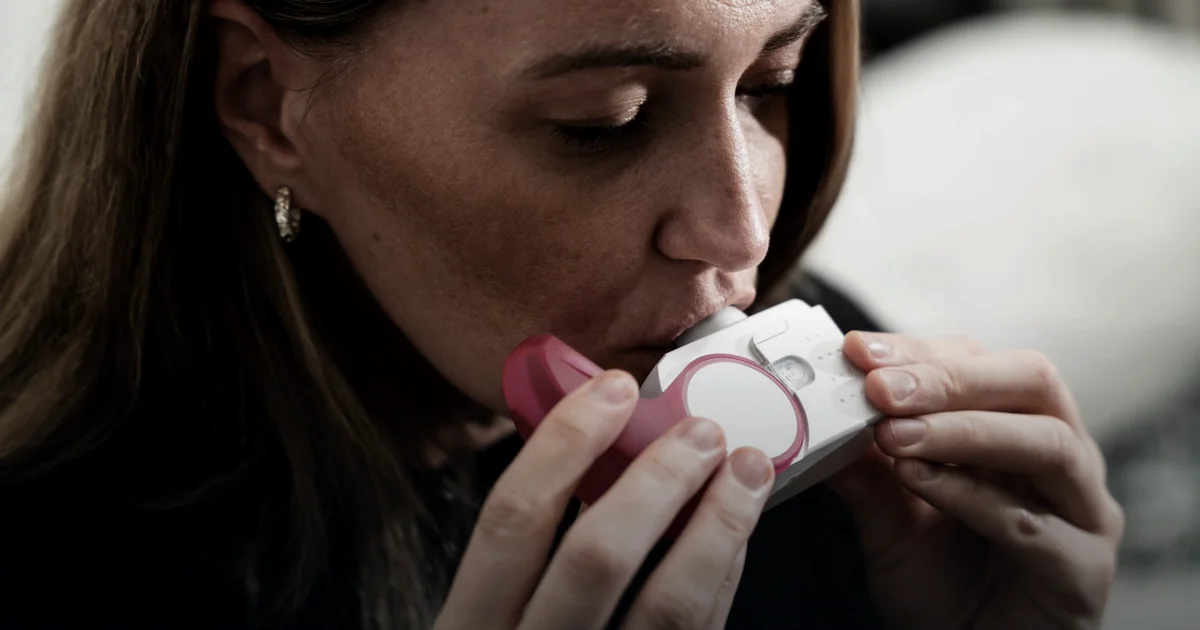
A familiar scene: the first ten minutes of interval work feel fine, then breathing gets heavy, the chest tightens, and you put it down to poor form, bad sleep or “not my day”. Sometimes that is exactly right. But for some runners, skiers and triathletes there is a specific physiological mechanism behind those sensations — exercise-induced bronchoconstriction (EIB). And it is far more common than people assume.
What it is and where it comes from
EIB is a transient narrowing of the airways during, or more often immediately after, intense exercise. Two concepts need separating straight away: this is not the same as asthma. Exercise-induced bronchoconstriction occurs in people with asthma, but it also occurs in people whose breathing at rest is entirely normal.
The leading explanation is the “osmotic” one. During intense work we move enormous volumes of air through the lungs, and we breathe through the mouth. The airway lining has to warm and humidify that air, and at high ventilation rates it simply cannot keep up and loses water. Dehydration of the surface triggers the release of inflammatory mediators, and the smooth muscle of the bronchi contracts.
That makes the list of risk factors named in the review easy to understand:
- cold dry air — which is why winter sports are a particularly high-risk group;
- chlorine in swimming pools;
- air pollution;
- high volume and intensity — that is, the very nature of endurance sport.
The result is an unpleasant logic: the more you train in an endurance sport, the greater your exposure to the triggers.
How common is it
The figures from the 2026 review are striking. Among elite athletes, EIB occurs in 10–50% — against 5–10% in the general population. The range is wide because it depends heavily on the sport and conditions: in winter disciplines the proportion is especially high, and in aquatic sports at the 2008 Olympics the figure reached 20%.
In endurance sport specifically — long distance running, duathlon and triathlon, cycling, cross-country skiing — prevalence estimates among elites run to around 13%. This is not a rarity but a widespread phenomenon that most amateurs simply never consider.
Why “going by symptoms” does not work
Here is the review's main practical conclusion, and it is counterintuitive: symptoms are poor predictors of EIB. Some athletes with confirmed airway narrowing feel almost nothing and attribute everything to fatigue. Others complain of breathlessness and chest tightness while objective testing finds nothing — the cause turns out to be something else (vocal cord dysfunction, for example, or plain lack of fitness).
A validated screening questionnaire that reliably filters for EIB simply does not exist — and the authors link this directly to widespread underdiagnosis.
So the diagnosis is made objectively. The main method is eucapnic voluntary hyperpnoea (EVH): the athlete breathes intensively from a special dry gas mixture, simulating exercise, with lung function measured before and after. The standard criterion is a fall in FEV₁ of 10% or more. Ordinary resting spirometry is of little use here: it can be completely normal.
Worth emphasising separately: self-diagnosis and “try someone else's inhaler” is a bad idea. First, it does not treat something you may not have. Second, beta₂-agonists and inhaled corticosteroids are governed by anti-doping rules, and they need to be used within WADA requirements, not on advice from a group chat.
What to do if you suspect it
The practical algorithm is simple.
- Establish the pattern. EIB more often appears 5–15 minutes after the start of intense work or immediately after it ends, and is noticeably worse in cold, dry air. If the picture repeats, that is grounds for investigation, not for another attempt to tough it out.
- See a doctor for an objective test, not for a diagnosis based on your description. What you need to ask for is provocation testing, not just resting spirometry.
- Manage the triggers. On freezing days, devices that retain the heat and moisture of exhaled air help — from specialised heat-exchange masks to a simple buff over the face. Sessions on high-pollution days are better postponed or moved indoors.
- Do not skip the warm-up. A gradual build-up before intense work reduces the severity of subsequent bronchoconstriction in many people.
- Treatment exists and works. The review describes a combined approach: inhaled corticosteroids, beta₂-agonists and non-pharmacological measures. The goal is not to give up sport but to remove the limiter.
This article is educational and does not replace consultation with a doctor. If you have the symptoms described, see a pulmonologist or a sports physician.
Key points
- EIB is a transient narrowing of the airways during exercise; it is not a synonym for asthma and occurs in people with healthy lungs at rest.
- The cause is water loss from the airway lining at high ventilation; triggers are cold dry air, chlorine, pollution, high training volume.
- Prevalence among elite athletes is 10–50% versus 5–10% in the population; in endurance sport estimates reach 13%, and 20% was recorded in aquatic sports.
- Diagnosis by symptoms is unreliable and there is no validated questionnaire — hence widespread underdiagnosis.
- An objective test is needed (EVH), with a criterion of a 10% fall in FEV₁; resting spirometry can be normal.
- The medications fall under WADA rules — self-medication is not acceptable, but with the right diagnosis the condition is well controlled.
Sources: “Exercise-Induced Bronchoconstriction in Athletes: A Narrative Review”, Quality in Sport, 2026. https://apcz.umk.pl/QS/article/view/73477. “Management of Exercise-Induced Bronchoconstriction in Athletes”, The Journal of Allergy and Clinical Immunology: In Practice. https://www.jaci-inpractice.org/article/S2213-2198(20)30252-X/fulltext