Hyponatremia on Long Distances: Why "Drink More" Is Dangerous Advice
A fresh 2025 review explains why at marathons and ultras people end up in intensive care more often because of too much water, not dehydration — and how to avoid it.
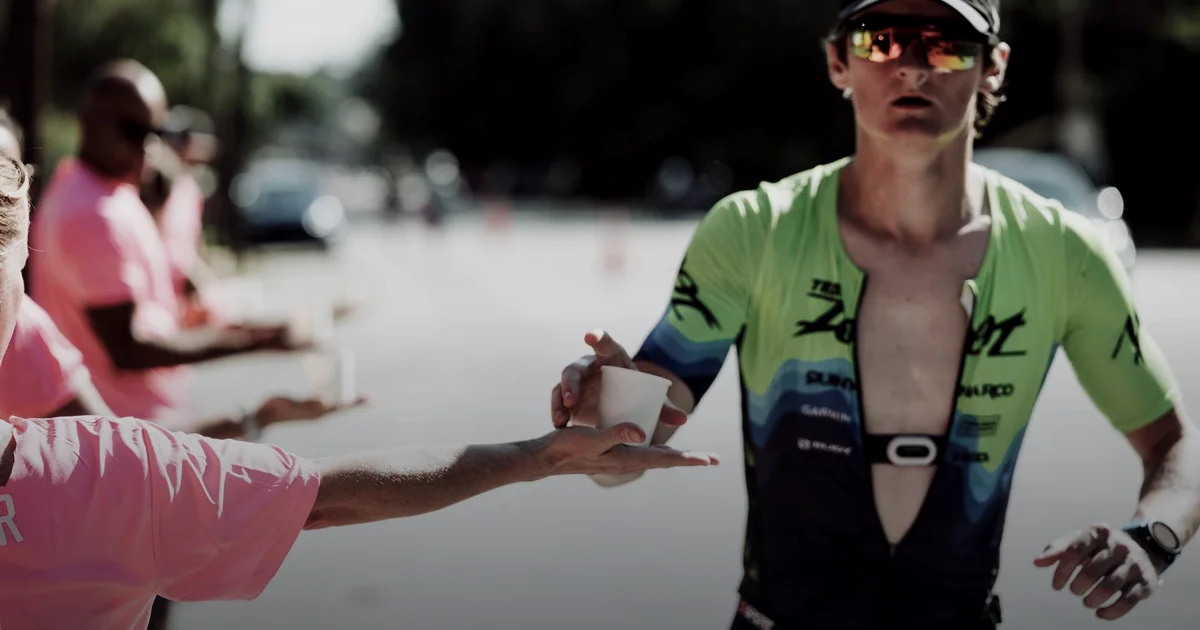
Many athletes fear dehydration and, on long distances, drink "just in case." The paradox is that at marathons and ultra races people land in intensive care far more often not from a lack of water, but from too much of it. A fresh 2025 review in the Journal of Endocrinological Investigation examines exercise-associated hyponatremia (EAH) — a condition in which the blood sodium concentration drops to <135 mmol/L. Let's break down the mechanisms and how to stay out of the danger zone at your next start.
What EAH is and how it develops
It used to be thought that this was the province of only the very longest races — ultramarathons and Ironman. But the review emphasizes: the condition also shows up in team sports and on shorter distances.
The problem has two main mechanisms:
- Fluid overload. When more water comes in than the body is able to excrete, the sodium in the blood is literally diluted.
- Inappropriate secretion of ADH (vasopressin). Exercise triggers a "non-osmotic" release of antidiuretic hormone — the kidneys retain water even when there is already too much of it.
The key takeaway: sodium loss through sweat plays a less significant role than commonly assumed. Ultramarathoners with hyponatremia showed markedly greater fluid retention, while their sodium losses were no different from those whose sodium was normal. In other words, the problem is almost always the water, not "washed-out salt."
How common it is and who is at risk
The numbers from the review:
- Asymptomatic EAH occurs in 5–70% of endurance-race participants (the huge spread is due to different distances and conditions).
- The symptomatic form — in 0.1–1.0% of athletes.
- At the 2005 Boston Marathon, hyponatremia was found in 13% of runners.
- Yet at the 2002 Christchurch Marathon, among 134 finishers there was not a single case.
Risk factors:
- a slow pace and time on the course longer than 4 hours (for marathoners);
- weight gain over the course of the race — a direct marker of overdrinking;
- hot weather and exercise lasting longer than 2 hours;
- lack of competitive experience;
- possibly female sex — but once adjusted for body mass, this factor is disputed.
The logic is simple: the longer you're on the course and the more water stations you pass through, the higher the chance of drinking too much.
The "drink as much as possible" myth
The old advice to "drink ahead of thirst" was born out of a fear of dehydration — and it is precisely what drove some athletes into hyponatremia. The review documents a paradigm shift: you should drink according to thirst — before, during, and immediately after exercise. Thirst is a sufficiently accurate physiological guide to keep you from overdoing it.
A separate word on salt: the authors note that there is insufficient evidence for the benefit of salt supplements in preventing EAH. If you've already overdrunk, the dilution effect "outweighs" the contribution of extra sodium — a salt tablet won't compensate for an extra liter of water.
How to apply this in practice
- Drink to thirst, not to a schedule. The guide is the sensation, not "a sip every 15 minutes at any cost."
- Weigh yourself before and after a long workout. The norm is a small drop in weight. If you're heavier after the finish, you're drinking too much. The water-loss calculator will help you estimate your expected fluid losses.
- Don't pour in water "just in case" at every aid station. Especially if you run slow and long — you're the one at maximum risk.
- Salt is not insurance against overdrinking. Electrolytes are useful, but they don't override the main rule: don't drink more than your body asks for.
- Know the red flags. Nausea, headache, swollen fingers, confusion against a background of copious drinking are grounds to stop drinking water immediately and seek help.
The bottom line
- EAH means sodium <135 mmol/L, and most often the cause is excess water, not salt loss.
- Two mechanisms: dilution of the blood by fluid and water retention due to a release of vasopressin under exercise.
- The at-risk group — slow athletes on distances longer than 4 hours who overdrink and gain weight over the course of the race.
- Prevention — drink to thirst; salt supplements do not compensate for overdrinking.
- Severe symptoms (confusion, vomiting, breathing difficulty) require emergency care — treatment includes hypertonic NaCl solution, not an infusion of plain water.
Source: Altieri B. et al., Journal of Endocrinological Investigation, 2025. https://link.springer.com/article/10.1007/s40618-025-02673-7