Hydration in sports: how much and what to drink before, during, and after exercise
The position stand of German sports nutritionists in plain terms: the working drink formula, fluid volumes, and why the advice 'drink before you're thirsty' is outdated.
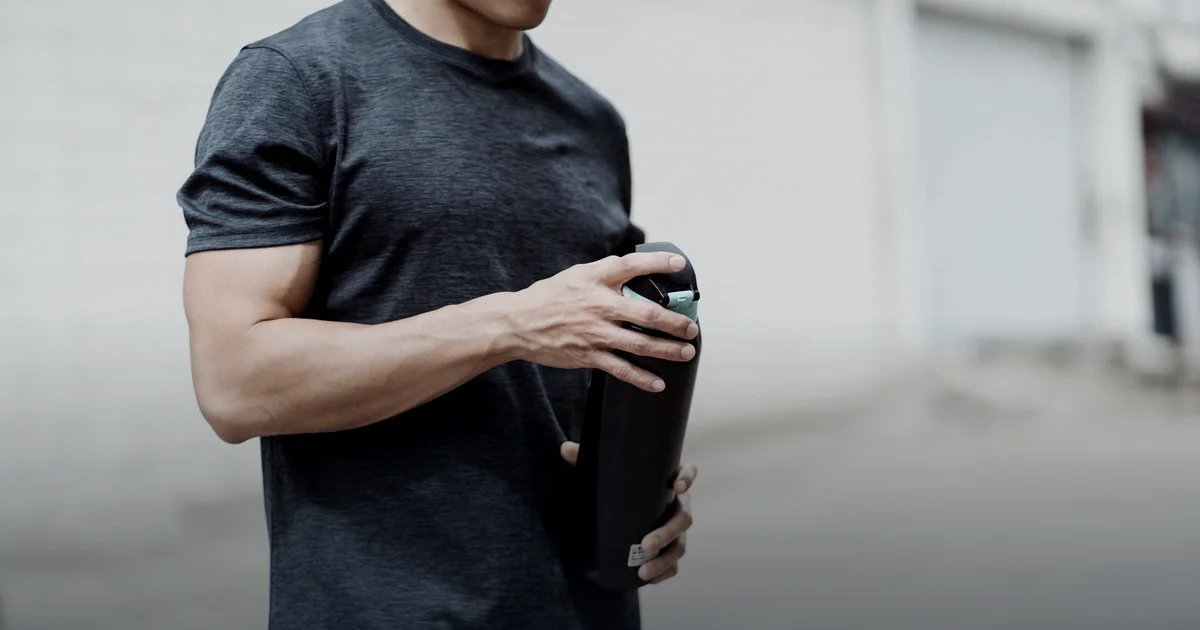
Hydration seems like a trifle next to your training plan — right up until your legs cramp or your head spins at kilometer 30. The position stand from the sports nutrition working group of the German Nutrition Society (Mosler et al.) distills the evidence into a single idea: both too little fluid and too much of it are harmful. Let's work out how to build your own protocol.
Heat, sweat, and water loss
During exercise, about 75% of the energy the body extracts from nutrients turns into heat. To keep the body's core from overheating, that heat has to be dumped, and the main mechanism here is sweating. The higher the intensity and the longer the effort, the hotter and more humid the air, the more you sweat. The paradox: trained athletes sweat earlier and more heavily than beginners — as VO2max rises, the sweat glands kick in faster. This isn't weakness but efficient cooling.
The scale of the numbers is striking. Under intense work in the heat you can lose 4-10 l of water and 3,5-7 g of sodium per day. Sweat rate varies from person to person — from 0,3 to 2,5 l/h. Sodium leaves along with the sweat: on average around 900 mg/l, but the individual spread is huge — from 175 to 1512 mg/l. If white salt streaks are left on your clothes and skin after training, you're a "salty sweater" and lose more salt than average.
Two extremes: dehydration and hyponatremia
Losing more than 2-4% of body weight already hits endurance, strength, and brain function: plasma volume drops, heart rate rises, and cramps, headache, and concentration problems appear. That's where the old advice "drink before you get thirsty" came from.
But excess water has a flip side — hyponatremia ("water poisoning"): when you drink more than you lose, plasma sodium falls <135 mmol/l. Symptoms include nausea, headache, confusion, and in severe cases brain swelling and death. This is no exotic rarity: in a Boston Marathon study, hyponatremia occurred in 13% of runners, and in three it was critical, below 120 mmol/l. The main sufferers are amateurs on courses lasting longer than 4 hours who drink "just in case" at every aid station.
The authors' conclusion is radical: trust your thirst. Those who drank by their sense of thirst avoided both extremes.
What to put in the bottle
A slightly hypotonic or isotonic drink is absorbed best. The working formula:
- Carbohydrates 4-8% — fuel and an accelerator of water absorption.
- Sodium 400-1100 mg/l — retains fluid and helps the gut soak it up (500-700 mg/l is enough for absorption).
- On long efforts — 30-60 g of carbs per hour.
Adding extra salt to the drink is worthwhile only if sweat pours very heavily (>1,2 l/h) and the effort lasts longer than 2 hours. A simple homemade version of a recovery drink: one part fruit juice to two parts unsweetened mineral water rich in sodium.
How to apply it in practice
Before the start. Arrive with a normal balance — urine light yellow. 2-4 hours before the effort, drink 5-10 ml per kg of body weight (for 70 kg that's roughly 350-700 ml). Don't load up "just in case": excess water only sends you to the toilet and dilutes sodium.
During. A workout up to 60 minutes with a normal start — you can skip drinking altogether. Longer than 60 minutes — drink; after 90 minutes and in team sports, add carbohydrates. A volume guideline is 0,4-0,8 l/h, but no more than 80% of your actual sweat loss. Athletes who drink to thirst usually take 300-600 ml/h.
Find out your loss (the weighing method). Weigh yourself without clothes before training, note the time, and weigh yourself afterward. The difference in kg ≈ liters of sweat; add what you drank during the session. Example from the document: 49,5 → 47,9 kg over 105 minutes = 1,6 l, that is 0,91 l/h.
After. If weight dropped <5% and there's no load in the next 24 hours, ordinary food with water is enough. If you need to recover quickly (next session within <12 h), drink about 1,5 l per each kg lost, in small sips, with electrolytes and together with food. Storing glycogen requires potassium, so salted drinks, juices, as well as low-fat milk and cocoa are good.
Key points
- About 75% of energy goes to heat; sweat is the cooling system, which is why trained athletes sweat more.
- Losing >2-4% of mass harms performance, but an excess of water is more dangerous — the risk of hyponatremia (<135 mmol/l).
- The main guideline is thirst, not a schedule of sips.
- The drink: 4-8% carbs + 400-1100 mg/l sodium; on long efforts, 30-60 g of carbs/h.
- Before: 5-10 ml/kg 2-4 h out. During: 0,4-0,8 l/h, at most 80% of loss. After: 1,5 l per kg for fast recovery.
- Determine your own sweat rate by weighing — it's more accurate than any universal tables.
Source: Mosler et al. — Fluid Replacement in Sports (Position Stand), German Journal of Sports Medicine. https://www.germanjournalsportsmedicine.com/fileadmin/content/archiv2020/Heft_7-8-9/DtschZSportmed_Position_Stand_Mosler_Fluid_Replacement_in_Sports_2020-7-8-9.pdf