Can’t sleep after evening intervals? What 4 million nights and a 2026 meta-analysis show
After a hard evening workout some people lie awake for ages, while others fall asleep instantly and wake up at four in the morning. A 2026 meta-analysis of randomised trials and data from 14,689 people wearing fitness bands agree: the problem is not the time of day as such, but intensity and how many hours are left before bed. We go through the numbers and what to do with them.
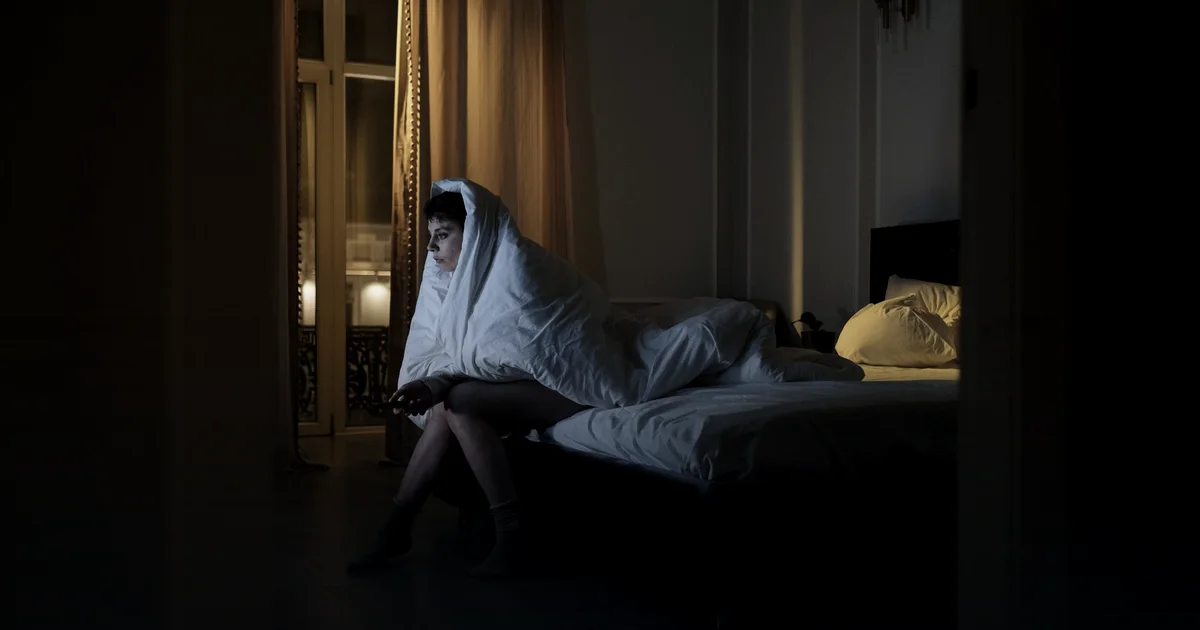
In October, one of the big Russian-language running Telegram channels ran a poll about sleep. 272 people voted, and almost half said they sleep 6–7 hours — “well, close enough to normal”. Two familiar complaints quickly surfaced in the comments. The first: after evening intervals you lie in the dark, your pulse pounding in your ears, and sleep just won’t come. The second: you drop off instantly, but at 3:40 your eyes open on their own and you can’t get back to sleep.
The advice “don’t train in the evening” has been around for a long time. Two recent papers tested how well founded it is — and the picture turned out to be more precise than a blanket ban.
The 2026 meta-analysis: morning versus evening
In August 2026, Sleep Medicine Reviews published a systematic review by Souabni, Saidi and colleagues (University of Toulon, with researchers from Columbia University and Aberdeen). Out of 1111 publications found, they selected 25 studies that directly compared morning and evening exercise. 16 randomised controlled trials went into the meta-analysis.
What they found:
- On most sleep measures, morning training had no clear advantage. Time to fall asleep, total sleep time, subjective quality — on average, no difference.
- One exception — sleep continuity. After evening or night-time exercise there was more wake time after sleep onset (WASO): standardised mean difference −0.51 (95% CI −0.89 to −0.12) in favour of morning exercise. The authors describe the effect as moderate and warn that it may be inflated by the “small-study effect”.
- The difference is more noticeable at high intensity. A subgroup analysis showed that the harder the exercise, the more clearly time of day made a difference.
Note: WASO is exactly that “woke up at four and just lying there”. Not trouble falling asleep, but broken sleep in the second half of the night.
4 million nights with a wearable
The second source is a paper by Leota and colleagues (Monash University, Australia) in Nature Communications in 2025. The researchers took data from 14,689 physically active people who wore a WHOOP band for a year — 4,084,354 nights in total.
The later a workout ended and the higher its load as estimated by the band, the:
- later the person fell asleep;
- shorter their sleep;
- lower its quality;
- higher their overnight resting heart rate;
- lower their overnight heart rate variability.
And the key practical figure: workouts that ended 4 hours or more before bedtime were not associated with sleep at all — at any load.
What earlier research said
In 2019, Stutz, Eiholzer and Spengler (ETH Zurich) published a meta-analysis of 23 studies with a single evening exercise session in Sports Medicine. Their conclusion was almost the opposite of conventional wisdom: overall, evening exercise did not disrupt sleep, and deep sleep even increased slightly (+1.3 percentage points). But there was a caveat: sleep onset, total sleep time and sleep efficiency may suffer after vigorous exercise ending less than an hour before bedtime. The higher the physical stress relative to a person’s usual level, the lower the sleep efficiency (−3.2 pp) and the more wake time during the night (+21.9 minutes).
Another 2026 meta-analysis (Hu and Chen, Frontiers in Psychology, 13 studies) found no consistent advantage of morning, afternoon or evening for sleep quality. Its conclusion: the fact that you exercise matters more than when.
What not to believe too firmly here
The wearable data are observational. People who train late may differ for other reasons too: work, stress, coffee, dinner. On top of that, two of the co-authors of the Nature Communications paper are WHOOP employees, and the bands themselves are poor at detecting night-time awakenings.
The WASO effect is moderate and possibly overstated. The authors of the 2026 review themselves ask for it to be interpreted with caution.
Most studies did not involve runners. The participants were healthy adults with varying fitness levels. Experienced runners after hard intervals were not singled out in these papers.
One bad night is not a disaster. We have looked at how even one sleepless night affects performance less than is commonly thought.
How to apply this
- Finish hard sessions 4 hours before bedtime if you have the choice. This is the clearest guideline in the data: beyond that threshold, the link with sleep disappeared.
- If evening is your only time, don’t stop training. The authors of the review in Sleep Medicine Reviews explicitly advise choosing a time that lets you train regularly, given your own constraints. Rearrange your week: intervals and tempo runs in the morning, or at lunchtime on weekends, and easy running in zone 2 in the evenings.
- Bring your body temperature down before bed. In the 2019 meta-analysis, a higher body temperature before bed was associated with lower sleep efficiency. A cool shower, an aired-out bedroom, and don’t go to bed straight after getting back from a run.
- Cut caffeine out of evening sessions. Caffeinated gels and pre-workout drinks in the evening are a common hidden culprit. We looked at how long caffeine stays in the blood in a separate article.
- Watch your overnight heart rate and HRV, not the “sleep score”. If your overnight heart rate is consistently higher than usual after evening intervals, that is a signal to move them. Why these measures are more useful than overall “recovery scores” is covered in our look at readiness scores.
The bottom line
- A 2026 meta-analysis of 16 RCTs: on most sleep measures morning is no better than evening, but evening exercise brings more night-time awakenings (SMD −0.51), especially at high intensity.
- Data from 14,689 people and 4.08 million nights: the later and harder the workout, the worse the sleep and the higher the overnight heart rate; workouts ending 4 hours or more before bedtime are not linked to sleep.
- A 2019 meta-analysis: on average, evening exercise does not disrupt sleep; the risk lies with vigorous exercise ending less than an hour before bedtime.
- In practice: keep intervals well away from bedtime, run easy in the evening, cool down before bed and no evening caffeine.
Sources: Souabni M., Del Sordo G.C., Saurel M. et al. “Effects of morning versus evening exercise on sleep: a systematic review of comparative studies with a meta-analysis of randomized controlled trials”. Sleep Medicine Reviews, 2026;90:102358. DOI: 10.1016/j.smrv.2026.102358 · Leota J., Presby D.M., Le F. et al. “Dose-response relationship between evening exercise and sleep”. Nature Communications, 2025;16:3297. DOI: 10.1038/s41467-025-58271-x · Stutz J., Eiholzer R., Spengler C.M. “Effects of Evening Exercise on Sleep in Healthy Participants: A Systematic Review and Meta-Analysis”. Sports Medicine, 2019;49(2):269-287. DOI: 10.1007/s40279-018-1015-0 · Hu X., Chen P. “Time-of-day effects of acute and regular exercise on sleep quality and mood: a three-level meta-analysis”. Frontiers in Psychology, 2026;17:1933599. DOI: 10.3389/fpsyg.2026.1933599