Massage gun: half an hour of mobility, not recovery
A fresh RCT reported enormous effects — so enormous they are hard to believe in groups of ten people. We unpack what percussion therapy reliably delivers, what it doesn't, and when it's better left alone.
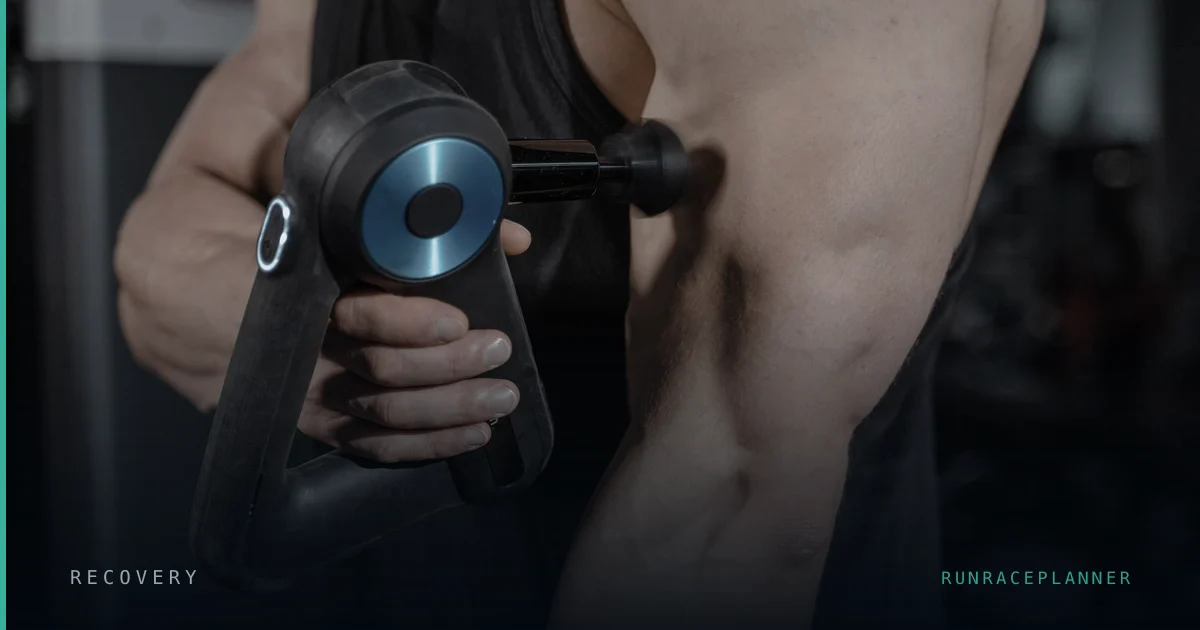
The massage gun has become the object that lives in everyone's bag and works in ways nobody can quite explain. It feels good afterwards, mobility seems to improve, and from that people conclude “accelerated recovery.” The literature supports that conclusion far more weakly than the marketing does — but the device isn't a completely useless gadget either. Let's work out where the line falls.
What holds up consistently
The most reproducible finding is a short-term increase in range of motion. Across various studies, percussion improved mobility and flexibility and reduced pain sensations, with gains in range of motion of up to 11.4% recorded for the hamstrings.
The key word is short-term. The effect is transient and doesn't last long after application. So as a “warm up before work” tool the gun is perfectly serviceable; as a way to change anything in the tissues over the long run — there is no data.
The mechanism here is the same as for any vibration or manual technique: a temporary reduction in tone, a change in receptor sensitivity, a raised pain threshold. Nothing mystical, but nothing long-lasting either.
Where the problems start
A recent randomised controlled trial (Frontiers in Public Health, 2025) compared three approaches to delayed onset muscle soreness (DOMS): static stretching, 25 minutes of percussion, and 40 minutes of percussion. The device was a fascial gun at a frequency of 53 Hz and an amplitude of 6 mm, treating the quadriceps, adductors, hamstrings, iliotibial band, and glutes.
The results look triumphant: at 48 hours the long protocol produced less pain, better range of motion, and markedly better jump performance.
And now the part the press releases leave out. The groups had 10 people each, and effect sizes reached d = 8.7 for jump height and d = 19.2 for peak ground reaction force.
For reference: an effect size of 0.8 is considered large in sports physiology. A value of 19 would mean the distributions of the two groups do not overlap at a single point anywhere — which practically never happens in living biology. Numbers like these usually say less about a method's miraculous power than about tiny within-group variability in a sample of ten. Treating these figures as the effect you should expect is not on.
And there is counter-evidence. A 2024 paper in the Journal of Athletic Training tested five minutes of application to the calves immediately after loading work: it found no meaningful effect on physical performance, and soreness in the first 4 hours actually rose slightly.
Adding it up: mobility — yes, briefly. Recovery — the evidence is contradictory and weak.
The safety issue people usually keep quiet about
The authors of that same 2025 study note separately that severe cases of rhabdomyolysis have been described following percussion therapy applied immediately after exercise.
Rhabdomyolysis is massive breakdown of muscle fibres with the release of myoglobin, which hits the kidneys. The logic of the risk is clear: after hard eccentric work the muscle is already damaged, and aggressive mechanical treatment adds injury on top of injury.
From that follow some simple rules:
- Don't aggressively treat a muscle you have just destroyed. Descents, plyometrics, a long race — none of these is a reason to run the gun at maximum power.
- Don't work over bony prominences, joints, or along major nerves and blood vessels. The front of the shin, the popliteal fossa, the groin, the neck — not for the gun.
- Less time and less pressure than feels necessary. The urge to “press in harder” isn't backed by anything.
How to use it sensibly
- Before training as part of the warm-up — 30–60 seconds per muscle group to raise mobility before the main work. This is the application that has data behind it.
- Between mobility sets — if you need range of motion here and now.
- Not instead of sleep, nutrition, and offloading. Everything that actually moves recovery lives in those three items, and the gun doesn't replace them.
- Not as a painkiller applied to a developing problem. If a specific spot starts hurting earlier in the run week after week, that's a signal to look at your load, not to mute it.
- Set expectations for half an hour, not a day. The effect is transient by definition.
Limitations
The evidence base here is frankly fragmentary: application parameters (frequency, amplitude, duration, attachment, pressure) differ from study to study, and comparing them is hard. Samples are small. The RCT under discussion involved only physically active young men — extending it to women, masters athletes, and other training levels doesn't work. Frequency was fixed at 53 Hz, so the study says nothing about other settings. And, as almost everywhere in recovery research, blinding the participant is impossible: a person knows they're being treated with a gun, and the main measured outcome is subjective soreness.
Key points
- The only consistently confirmed result is a short-term increase in range of motion (up to ~11% for the hamstrings), and it fades quickly.
- A fresh RCT reported effects of d = 8.7 and d = 19.2 in groups of 10 people — biologically implausible values that cannot be taken as the expected result.
- Counter-evidence from 2024: five minutes immediately after exercise didn't help, and soreness in the first 4 hours rose slightly.
- Cases of rhabdomyolysis have been described after percussion applied right after exercise — don't aggressively treat a muscle you've just destroyed.
- Sensible use is warm-up and mobility, not “accelerated recovery.”
- The priority still belongs to sleep, nutrition, and offloading.
Sources: “The effect of percussion massage therapy on the recovery of delayed onset muscle soreness in physically active young men — a randomized controlled trial”, Frontiers in Public Health, 2025. https://doi.org/10.3389/fpubh.2025.1561970. “Effect of percussive massage treatment and static stretching on muscle tone, stiffness, and strength recovery after exercise-induced muscle fatigue: A randomized controlled study”, 2025. https://doi.org/10.1016/j.smhs.2025.05.004. Review data on percussion therapy: https://pmc.ncbi.nlm.nih.gov/articles/PMC10499144/