DOMS is not lactic acid: why your muscles hurt a day later and what is known about recovery methods
After a hard session, lactate starts clearing from the blood right away, while you are still resting, yet the muscles ache a day or two later — and worst of all after downhills, where lactate hardly rises. A 2026 network meta-analysis compared 35 randomised trials of recovery methods: whole-body cryotherapy and light therapy reduced soreness most noticeably, but confidence in these findings is very low. We look at what works and what remains a ritual.
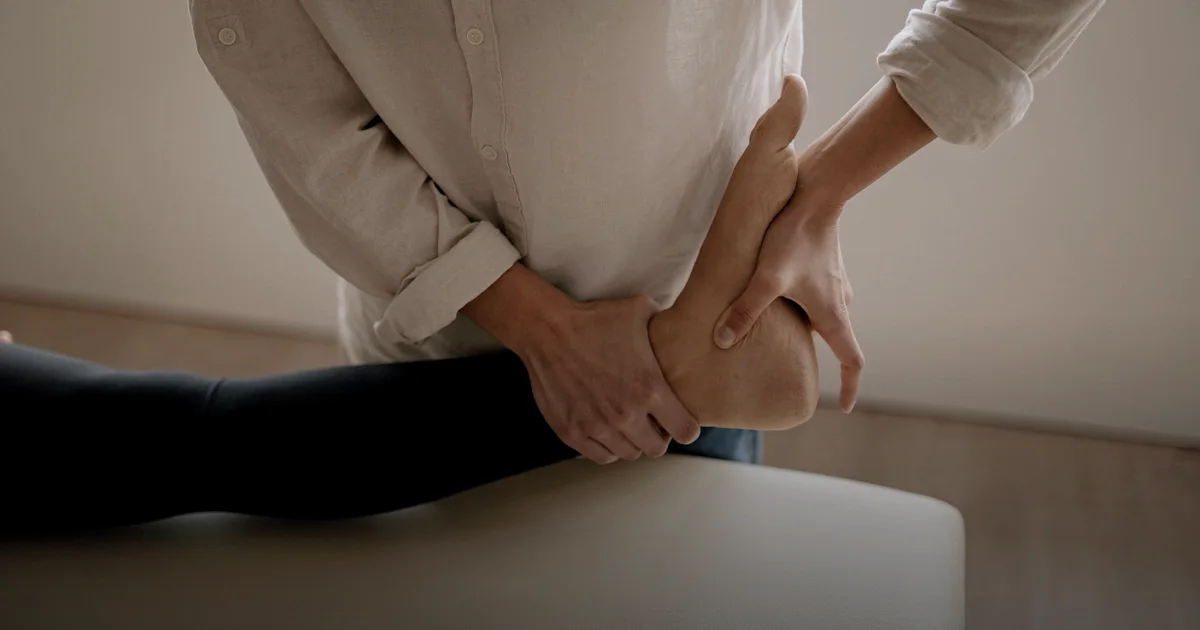
Monday after a long run, or after your first interval session following a break. Going down the stairs is a struggle, and someone in the running chat is bound to tell you to “flush the lactic acid out of your legs”. Why muscles ache after training is one of the questions runners ask most often, and almost every other answer blames lactic acid. It is one of the most persistent myths in sport. Let’s look at what actually hurts and what can help.
Lactic acid has nothing to do with it
This was tested back in 1983. Schwane, Armstrong and colleagues (The Physician and Sportsmedicine) had people run for 45 minutes on a treadmill in two versions: on the level and downhill at a −10% grade.
- On the level, blood lactate rose, but there was no muscle soreness.
- Running downhill, lactate did not rise, yet the muscles were noticeably sore the next day.
If the soreness were caused by acid, the result would have been the opposite.
Lactate doesn’t stay in the muscles for a day anyway. In a Scottish study by Menzies and colleagues (Journal of Sports Sciences, 2010), after 5 minutes of running at 90% of VO₂max, lactate rose from 1.0 to 3.9 mmol/L. With light activity it cleared faster than with passive rest, and fastest of all at an intensity of 80–100% of lactate threshold. The American physiologist George Brooks (Cell Metabolism, 2018) summarised decades of research: lactate is a fuel and a signalling molecule, not a waste product. It is burned by the muscles and the heart.
What actually hurts
DOMS, or delayed-onset muscle soreness, appears after unaccustomed and especially eccentric exercise — when a muscle works while lengthening. That means downhills, jumps, the first strength sessions after a break, a new type of exercise. Soreness peaks 24–72 hours after the session.
The Japanese physiologists Mizumura and Taguchi (The Journal of Physiological Sciences, 2016) described the mechanism. After eccentric work, the muscle releases neurotrophic factors (NGF and GDNF) — proteins that act on nerve endings. These make the pain nerve endings more sensitive. That is why the muscle hardly hurts at rest but does hurt when you stretch it, press on it or load it.
Another important detail: how much it hurts is a poor guide to how much damage there is. Severe DOMS doesn’t mean your muscles are “torn”, and no soreness doesn’t mean the session was wasted.
What the 2026 network meta-analysis showed
Li, Wang, Wei and Liu from Shenyang Sport University (Frontiers in Bioengineering and Biotechnology, October 2026) pooled 35 randomised trials. They compared about fifteen recovery methods: cold water, contrast showers, whole-body cryotherapy, compression, kinesio taping, vibration, electrical stimulation, stretching, massage, acupuncture, shockwave therapy, phototherapy and low-level laser therapy. Soreness was rated on a scale from 0 to 100 mm.
- Whole-body cryotherapy reduced soreness the most: by 39 mm at 24 hours and by 40 mm at 48 hours compared with control.
- Photobiomodulation and phototherapy (exposure to red and infrared light) — by 18–19 mm at both time points.
- Creatine kinase, a marker of muscle damage, was lowest after low-level laser therapy: at 48 hours, about 500 U/L lower than in the control group.
- For cold water, compression, massage and stretching, this analysis found no reliable reduction in soreness. Cold water showed only a favourable signal for the inflammatory marker IL-6, but the authors call it exploratory — there are too few data.
What not to believe too firmly here
The cryotherapy effect rests on one small study. It is a crossover trial in 12 men, middle- and long-distance runners. The range of the estimate is very wide: from −9 to −69 mm. This means the effect could turn out to be either huge or barely noticeable.
The authors rated the certainty of the evidence as very low. Most methods were compared not directly with each other but via the control group. They did not define in advance what difference in soreness counts as noticeable.
Soreness is not the same as recovery. This analysis did not compare muscle strength or athletic performance. A method that dulls pain does not necessarily bring your form back faster.
Other reviews, built differently, have found a small effect of massage and compression. The outcome of a network meta-analysis depends heavily on which studies are included.
The 1983 study is old and small, but its main conclusion has been confirmed many times since.
How to apply this
This article does not replace a consultation with a doctor. Sharp pain in one spot, significant swelling, pain lasting more than a week or dark urine after hard exercise is not DOMS — it is a reason to see a doctor urgently.
- There is no need to “flush out” lactic acid. Lactate clears from the blood on its own, while you are still resting, and next-day soreness has nothing to do with it. A cool-down may feel nice, but it won’t prevent DOMS.
- The best prevention is gradual progression. Introduce downhills, jumps, strength work and the first interval sessions after a break in small doses. Muscles adapt quickly: the next similar session hurts much less. More in our article on downhill running and muscle damage.
- While it hurts, keep moving easily. Easy running, cycling or walking in zone one or two; the zones generator will calculate your zone boundaries. The soreness usually eases after a warm-up.
- Don’t schedule key sessions or races at peak soreness — 24–72 hours after unaccustomed exercise.
- Whole-body cryotherapy and light therapy are optional, not essential. If they are available, they may reduce soreness, but the evidence is weak. On the downsides of ice baths, see our article on cold-water immersion; on massage guns, our separate review.
- Don’t try a new recovery method for the first time before a race.
The bottom line
- Lactic acid does not cause DOMS: lactate starts clearing from the blood right after exercise, and after downhill running the soreness is severe while lactate barely changes.
- DOMS is caused by unaccustomed eccentric exercise: afterwards the muscle releases neurotrophic factors, which make it sensitive to movement and pressure for 24–72 hours.
- In a meta-analysis of 35 studies, soreness was reduced most noticeably by whole-body cryotherapy (by 39–40 mm on a 100 mm scale) and phototherapy (by 18–19 mm), but the certainty of the evidence is very low.
- In practice: introduce new loads gradually, keep moving easily while it hurts, and don’t schedule key sessions at peak soreness.
Sources: Li J., Wang S., Wei M., Liu W. “Effects of different recovery and regeneration modalities on delayed-onset muscle soreness and post-exercise muscle damage markers: a systematic review and network meta-analysis”. Frontiers in Bioengineering and Biotechnology, 2026;14:1956053. DOI: 10.3389/fbioe.2026.1956053 · Schwane J.A., Watrous B.G., Johnson S.R., Armstrong R.B. “Is lactic acid related to delayed-onset muscle soreness?”. The Physician and Sportsmedicine, 1983;11(3):124-131. DOI: 10.1080/00913847.1983.11708485 · Menzies P., Menzies C., McIntyre L., Paterson P., Wilson J., Kemi O.J. “Blood lactate clearance during active recovery after an intense running bout depends on the intensity of the active recovery”. Journal of Sports Sciences, 2010;28(9):975-982. DOI: 10.1080/02640414.2010.481721 · Brooks G.A. “The science and translation of lactate shuttle theory”. Cell Metabolism, 2018;27(4):757-785. DOI: 10.1016/j.cmet.2018.03.008 · Mizumura K., Taguchi T. “Delayed onset muscle soreness: involvement of neurotrophic factors”. The Journal of Physiological Sciences, 2016;66(1):43-52. DOI: 10.1007/s12576-015-0397-0