Beer after the finish line: what actually happens to your recovery
We break down how alcohol after a workout hits muscle protein synthesis, sleep, and rehydration — and how to drink so you lose less. No moralizing: just data and practice.
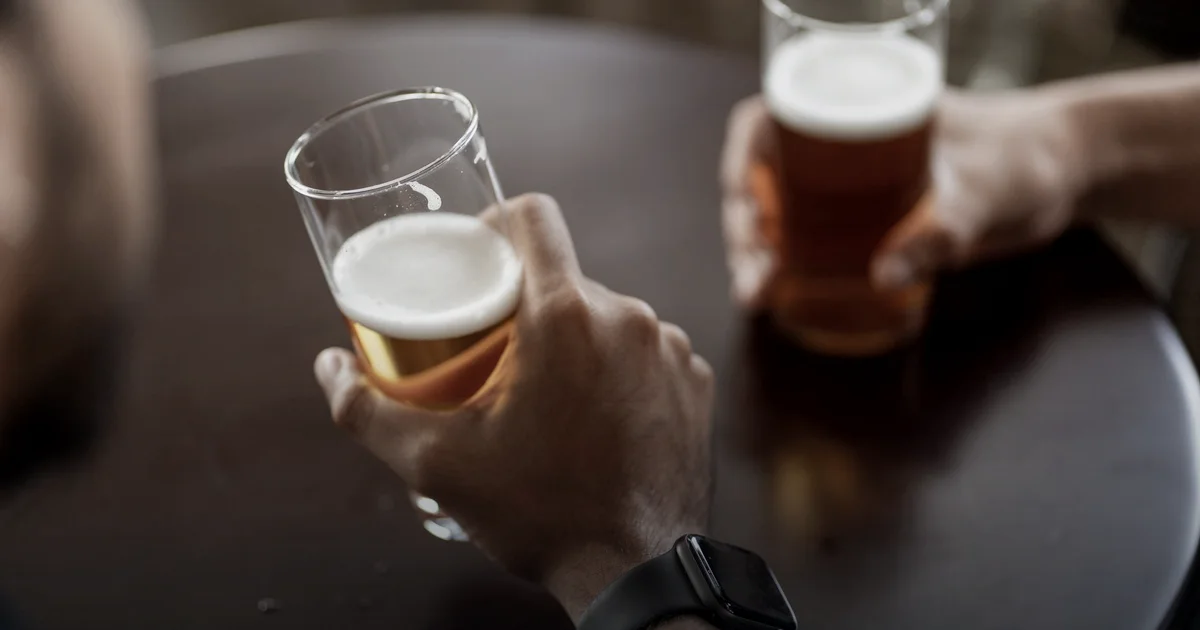
The finish arch, a medal, a cold beer in the recovery zone. It is a ritual, and arguing with it is pointless — it is part of endurance culture. But it is worth understanding that at exactly this moment the body is doing the most important work of the entire day, and alcohol does not fit into it well. The good news: almost all of the damage is a question of dose and timing, not of a total ban.
What happens to your muscles
The most telling study here is the work of Parr and colleagues (PLOS One, 2014). Eight physically active men completed a combined session: 8×5 leg extensions at 80% of 1RM, 30 minutes of cycling, and 10×30 seconds of high-intensity intervals. Then came three recovery conditions:
- 25 g of whey protein immediately after and again 4 hours later (the PRO condition);
- alcohol + protein — 1,5 g of ethanol per kg of body mass plus the same 25 g of protein;
- alcohol + carbohydrate — the same ethanol plus 25 g of maltodextrin instead of protein.
Myofibrillar protein synthesis rates across the 2–8 hour recovery window: 0,052%/h on protein, 0,039%/h (−24%) with alcohol plus protein, and 0,032%/h (−37%) with alcohol and no protein. All three conditions were above rest (0,025%/h) — meaning the anabolic response does not disappear, but it is noticeably clipped.
At the signalling level the picture is the same: mTOR phosphorylation 2 hours after exercise was roughly 297% above rest in the protein condition, versus ~157% with alcohol and protein and ~125% with alcohol and carbohydrate. Protein partially protects — but it does not cancel the effect.
An important detail about the dose: 1,5 g/kg is a lot. For an 80 kg athlete that is roughly a dozen standard drinks; in the study blood concentration peaked 4 hours after exercise and stayed up across all 8 hours of recovery. The review by Vella and Cameron-Smith (Nutrients, 2010) adds that the suppression of mTOR and protein synthesis depends on dose and timing — meaning one glass and an evening at the bar are different stories.
Sleep, water, and glycogen
Sleep. Alcohol breaks sleep architecture: depth decreases, REM time shrinks, and the share of light stage one grows. Drinking in the evening suppresses melatonin production. Subjectively you fall asleep faster — objectively the second half of the night falls apart, and that is exactly when recovery happens.
Water. Ethanol is a powerful diuretic: roughly 10 ml of extra urine for every gram of ethanol consumed. The effect shows up with drinks stronger than 4% through suppression of antidiuretic hormone. On top of that, peripheral vasodilation increases fluid loss through evaporation. So after a long session, when you are already in a fluid deficit, alcohol digs that hole deeper.
Glycogen. Here it is more honest to speak cautiously. The review describes the influence as “moderate” — primarily when alcohol displaces carbohydrate in the diet at equal calories. When glycogen restoration over 24 hours was assessed, no long-term harm was found. The main mechanism here is not biochemistry, it is crowding out food.
Thermoregulation and injury. Alcohol lowers core temperature through central mechanisms, and reduced work tolerance has been shown in both heat and cold. Separately: a moderate dose amplifies strength loss after eccentric exercise — meaningful drops in torque at 36 hours, especially with 1 g/kg taken immediately after the session. Data on immunity are contradictory, and under intense training loads it simply has not been studied.
How to limit the damage
A practical order of operations if you drink:
- Water and electrolytes first. Replace sweat losses before the first glass, not after the third.
- Then food with protein and carbohydrate. Even partial mTOR protection beats none, and a proper meal keeps alcohol from pushing carbohydrate out of your daily intake.
- Only then alcohol — and better an hour or ninety minutes after the finish, not at the moment protein synthesis is peaking.
- Not the evening before a key session or a race. Even a couple of glasses will ruin the second half of the night.
- Extra caution in the heat. A dehydrated body and disrupted thermoregulation are a bad combination.
About the finish-line beer: physiologically it is the worst possible moment — you are dehydrated, overheated, and the anabolic response is at its peak. Softening it is simple: half a litre of water or sports drink first, then food, then the ritual glass — and one, not five.
Two myths worth closing. Beer is not a sports drink: the electrolyte concentration in it is negligible, and ethanol works against rehydration. And alcohol does not “help you recover through sleep”: it speeds up falling asleep and degrades the structure of sleep itself.
Limitations
Parr's study had only 8 participants, all men, and a dose of 1,5 g/kg that is well above the typical “beer after the finish”. There is no direct data on how protein synthesis behaves with one or two drinks. The 2010 review states plainly: human data on muscle synthesis under exercise conditions are lacking, and on immunity during intense training there simply are none. All of this is a signal about the direction of the effect, not a precise scale for “what one pint costs”.
Key points
- Alcohol after a concurrent training session reduced myofibrillar protein synthesis by 24% with protein and by 37% without it.
- mTOR phosphorylation fell accordingly: ~297% above rest on protein versus ~157% and ~125%.
- Protein partially protects — if you drink, eat protein and carbohydrate before it, not instead of it.
- Diuresis: ~10 ml of extra urine per gram of ethanol — rehydration has to come first.
- Sleep suffers in the second half of the night: less REM, more light stages, suppressed melatonin.
- For glycogen the effect is moderate and works mainly by pushing carbohydrate out of the diet.
- The worst moment is right after a hard session, in the heat, and on the eve of a key race.
Sources: Parr EB, Camera DM, Areta JL, Burke LM, Phillips SM, Hawley JA, Coffey VG. Alcohol Ingestion Impairs Maximal Post-Exercise Rates of Myofibrillar Protein Synthesis following a Single Bout of Concurrent Training. PLOS ONE, 2014. https://doi.org/10.1371/journal.pone.0088384 · Vella LD, Cameron-Smith D. Alcohol, Athletic Performance and Recovery. Nutrients, 2010;2(8):781–789. https://doi.org/10.3390/nu2080781