“Eat less, run faster”: how an energy deficit breaks a runner's bones
A chronic calorie shortfall hits hormones and bones and raises the risk of stress fractures. We break down the latest 2026 studies and the signs of RED-S that are important not to miss.
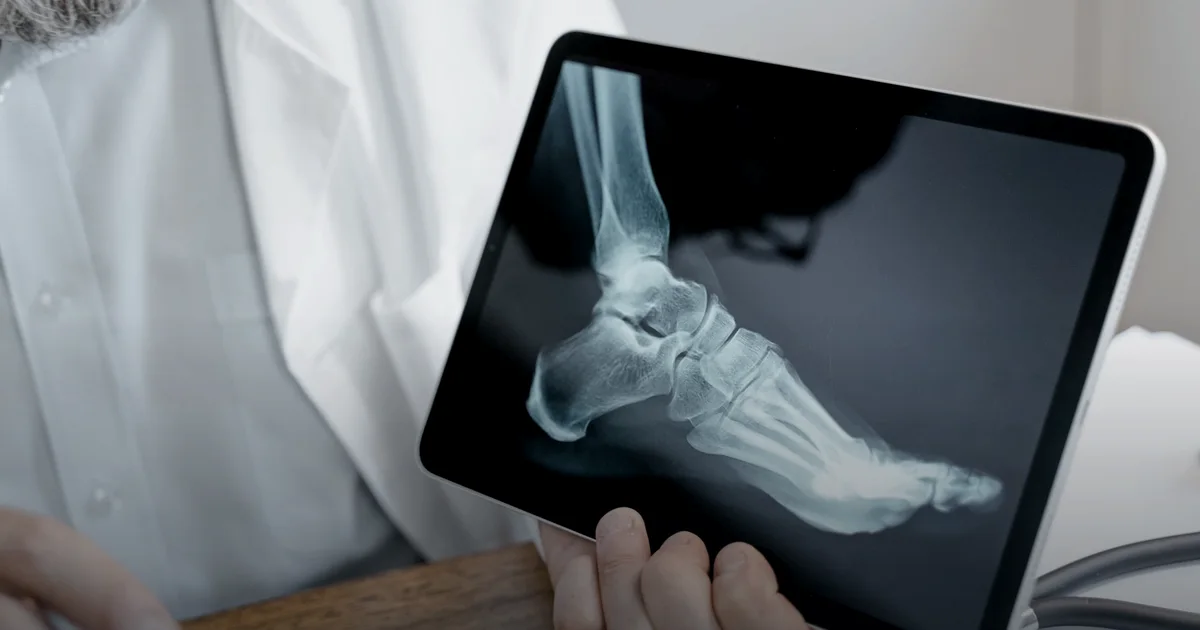
Among recreational runners a stubborn myth lives on: the lighter you are, the faster you go. Cut your portions, drop a couple of kilograms — and a personal best already feels closer. Sometimes this really does work for a few weeks. But then a pinpoint pain shows up in the foot or shin and won't go away — and the season is over. More often than not the cause is neither “weak bones” nor bad luck, but the fact that the body has been chronically short of energy. Let's look at how this works and what two recent 2026 studies show.
How an energy deficit breaks bones
The key concept is energy availability: how much energy the body has left for all its vital processes after training expenditure has been subtracted. If calorie intake is consistently < expenditure, the body switches into an economy mode. This is exactly what RED-S is — relative energy deficiency in sport.
This economy drive hits the “non-essential” first: sex hormone levels drop (in women the menstrual cycle becomes irregular or disappears, in men testosterone and libido fall), the thyroid suffers, and the renewal of bone tissue slows down. Bone is a living organ: running gives it microdamage and it is constantly being repaired. When energy and hormones are lacking, repair falls behind breakdown. This is how bone fatigue accumulates, ending in a stress fracture.
Important: impact loading itself is good for bone. It is precisely the foot striking the surface and jumping that force bone to become stronger. The problem arises when the loading is there but the energy for recovery is not.
What the recent studies show
Study 1 (Stellingwerff et al., Sports Medicine, 2026). The researchers examined 213 elite athletes (143 women, 70 men) from 13 sports, measuring bone density by DXA and assessing RED-S risk with the IOC tool. Athletes from “high-impact” sports had a markedly higher femoral neck density (Z-score 1.4 versus 0.4–0.5 in sports with low and medium impact loading). The main conclusion: impact loading affects bone density independently of RED-S status, so DXA results should be read with an adjustment for the specific sport rather than against general norms. Another figure: a recent stress fracture (within the past two years) raised the odds of a new one roughly threefold.
For runners this is sobering: running is a repetitive load, but in terms of peak “impact” it is lower than jumping or gymnastics. So you shouldn't count on automatically strong bones — which makes energy and varied strength work all the more important.
Study 2 (172 Italian track-and-field athletes, BMC Sports Sci Med Rehabil, 2026). A retrospective survey of sprinters, hurdlers, and distance runners; women additionally filled out the LEAF-Q questionnaire to assess the risk of low energy availability. About half of the participants had suffered a stress fracture at least once in their career. In distance runners the foot and shin were affected more often. In women the only significant predictor turned out to be the age of first menstruation: each additional year was associated with roughly a 20% increase in the number of fractures; menstrual cycle disturbances were also accompanied by more injuries. At the same time, men and women did not differ in the total number of fractures — meaning this is not a women-only problem.
Signs and prevention
How to suspect low energy availability. Warning signs: an irregular or absent menstrual cycle, constant fatigue, frequent colds and injuries, a plateau or decline in results despite training, perpetually cold hands, low mood, a history of stress fractures.
Why “eating less” is dangerous. A calorie shortfall doesn't make you faster — it shuts down hormones, weakens bones, and in the long run drags your performance down. Adequate nutrition is not a “weakness” but a foundation.
- Carbohydrates are the fuel of training; it is their deficit that drives you into negative energy availability the fastest.
- Protein is the material for recovery and the bone matrix.
- Calcium and vitamin D are needed by bone as building material (in detail — in a separate article on calcium); the general principle: without them even correct loading will not deliver strength.
Strength and plyometrics. Bone grows stronger under load — add 2 strength sessions a week and short jumping (plyometric) exercises. This is an extra stimulus that pure running lacks.
Early signs of a stress fracture. A local, pinpoint pain in one specific spot that grows worse as the load increases; in later stages it hurts even at rest and at night. If you can put your finger on a single point, and the longer you run the more it hurts, that is a red flag.
When to see a doctor urgently. Pinpoint, escalating pain, pain at rest, missed periods, recurring fractures. Don't run “through the pain” and don't diagnose yourself.
Disclaimer. This material is educational in nature and does not replace a consultation. If you suspect a stress fracture or RED-S, consult a sports physician.
Limitations
Both studies were carried out on elite athletes, with a retrospective and cross-sectional design. This means that associations were found, not proven causes. A telephone survey carries the risk of recall errors, and the authors themselves explain the link with the type of surface by the influence of the era rather than the surface itself. The figures cannot be transferred directly to a recreational runner — but the general principle that “energy and varied loading protect bone” holds firm.
The bottom line
- A chronic calorie shortfall relative to expenditure disrupts hormones and bone health — this is RED-S, and it raises the risk of stress fractures.
- Impact loading and adequate energy protect bone; for runners energy is especially important, since running's “impact” is moderate.
- “Eat less = faster” is a dangerous myth: hormones, bones, and performance itself are all at stake.
- Eat enough, don't cut carbohydrates and protein; remember calcium and vitamin D; add strength work and plyometrics.
- The early sign is a pinpoint pain that intensifies under load. If you suspect it — see a sports physician urgently.
Sources: Stellingwerff T., Tsai M.C., McCluskey W.T.P. et al. “Sport-Specific Impact Loading is Associated with Bone Mineral Density in Athletes: Implications for Relative Energy Deficiency in Sport (REDs) Assessment”. Sports Medicine, 2026. https://doi.org/10.1007/s40279-026-02478-5. Bone stress injuries in elite Italian track and field athletes: intrinsic and extrinsic risk factors. BMC Sports Science, Medicine and Rehabilitation, 2026. https://doi.org/10.1186/s13102-026-01639-3