Menthol mouth rinse: fooling the brain with cold without cooling the body
Rinsing the mouth with a menthol solution every six minutes raised mean power by 1.67% in the heat. The body does not actually cool — only perception changes. Here is where that helps and where it gets dangerous.
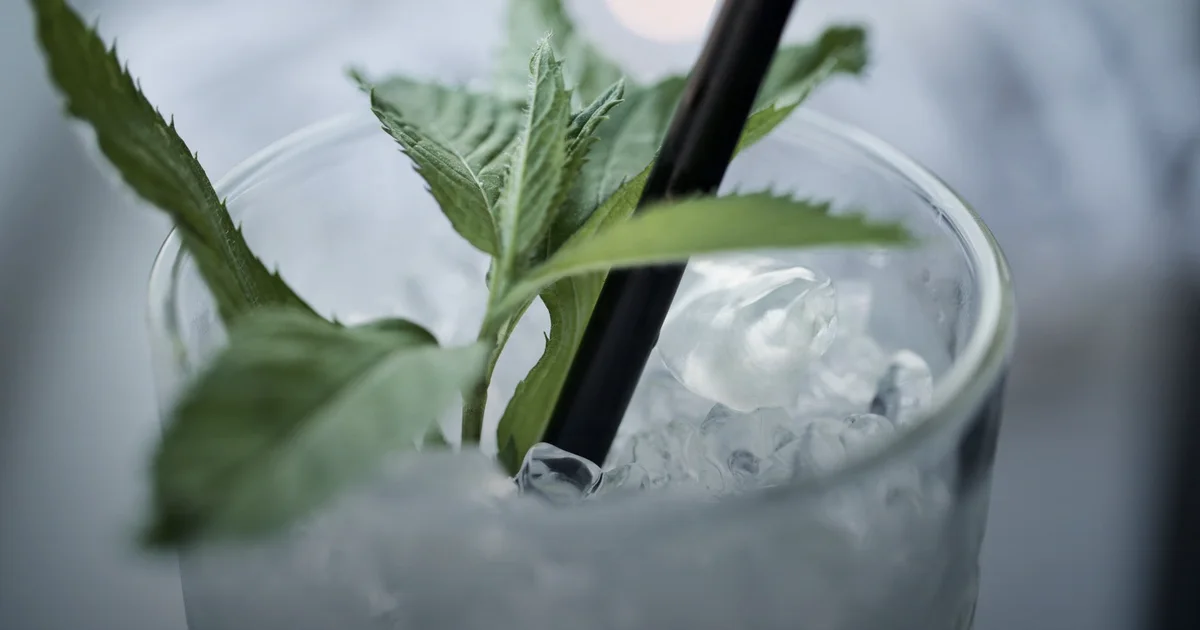
Some tricks work through perception rather than physiology. Carbohydrate mouth rinsing is the best-known example: a solution you do not even swallow improves performance because receptors in the mouth tell the brain that fuel is arriving. Menthol is built on the same idea, but it fools a different channel — the thermal one.
How it works
Menthol binds to the TRPM8 receptor — the very one responsible for the sensation of cold. The receptor cannot tell real cooling from a chemical stimulus: it simply reports «cold» to the brain. Hence the fresh feeling from mint gum.
The key point to grasp straight away: the body is not cooled by this. Neither core temperature nor skin temperature changes. The only thing that changes is the signal arriving at the brain.
Why that is useful becomes clear if you remember why pace drops in the heat. A large share of that slowdown is not physical muscle failure but regulation: the brain receives signals of a rising heat load and cuts power output pre-emptively, before dangerous overheating sets in. Mix a «cool» signal into that stream and the protective brake eases off.
What the study showed
The paper was published in Nutrients in April 2026.
The participants were 10 trained adolescent male cyclists, mean age 16.7 ± 1.3 years. Conditions — 31.45 ± 0.59 °C. The design: randomised single-blind trials, a modified variable-load cycling test.
The protocol is simple: a rinse with a 0.01% L-menthol solution or placebo every 6 minutes during the work.
Results:
- Mean power rose by 1.67 ± 1.59% — 177.1 ± 33.0 W versus 174.1 ± 32.1 W (p = 0.002). The gain was more pronounced on the high-intensity segments.
- Cadence — 87.4 ± 5.1 versus 84.5 ± 5.2 rpm (p = 0.027).
- Electromyography: in the menthol condition, activation of vastus lateralis and rectus femoris was lower over time than on placebo.
That last point is the most interesting of the three. Less electrical activity in the muscle alongside more power delivered is indirect evidence that the issue is not the muscle but how it is being commanded. Which is to say the mechanism really is central, not peripheral.
What to keep in mind here
The sample is tiny and specific. Ten people, all male, mean age just under 17. Adolescent thermoregulation differs from adult thermoregulation, and there were no women in the study at all. You cannot transfer this result directly to a forty-year-old female marathoner.
The absolute numbers are modest. Mean power around 175 W says these are mid-level juniors, not elites. How the trick behaves in an athlete putting out 300 W is unknown.
The gain is small. 1.67% is statistically significant (p = 0.002) but practically slight. And the spread of ±1.59% is almost equal to the effect itself: for some participants the increase was near zero.
Blinding was one-sided. Menthol cannot be hidden — the subject always knows what is in their mouth. Part of the effect may be expectation, and in studies of this kind that is fundamentally impossible to remove.
Where it fits and where it is dangerous
It fits:
- hot races with high-intensity segments — where the effect actually showed up;
- aid stations, if the solution is convenient to carry;
- paired with real cooling, not instead of it.
Now for the danger, and this is not a formality.
Menthol removes part of a protective sensation. Heat discomfort is not a whim of the body but a signal that makes you back off before things go bad. Dull that signal and you gain the ability to work harder in conditions where the body carries on heating up exactly as before. In the study the participants were monitored; out on the course nobody is monitoring you.
Hence: menthol is for competition under controlled conditions, not for heroic conquest of a furnace. And it in no way replaces heat acclimation, rehydration and pre-cooling — those work on heat transfer itself, not on the perception of it.
How it differs from carbohydrate rinsing
Both tricks act through the mouth and both are central, but the channels differ:
- carbohydrate activates receptors tied to the reward system and works when the body is expecting fuel — that is, especially during fasted work;
- menthol acts on thermal perception and works specifically in the heat.
They are not competitors and are theoretically compatible — but combined use, as far as is known, has not been tested.
Key points
- Menthol binds to the TRPM8 receptor and produces a sensation of cold without cooling the body.
- The 2026 study: 10 trained adolescent male cyclists, 16.7 ± 1.3 years, temperature 31.45 °C, a rinse with 0.01% L-menthol every 6 minutes.
- Mean power +1.67 ± 1.59% (177.1 versus 174.1 W, p = 0.002), cadence 87.4 versus 84.5 rpm (p = 0.027).
- Thigh muscle activation on EMG was lower at higher power — a sign of a central rather than muscular mechanism.
- The limitations are substantial: 10 male adolescents, low absolute power outputs, a spread almost equal to the size of the effect, one-sided blinding.
- The main risk: the trick dulls the protective signal about overheating without changing the overheating itself.
- It does not replace acclimation, drinking and real cooling — it works on top of them.
Sources: «Effects of Menthol Mouth Rinsing on Performance and Surface EMG Activity During Heat-Stressed Cycling», Nutrients, 2026;18(7):1134. https://doi.org/10.3390/nu18071134, https://pmc.ncbi.nlm.nih.gov/articles/PMC13074397/. «Menthol Mouth Rinsing Improves Cycling Performance in Trained Adolescent Males Under Heat Stress», International Journal of Sport Nutrition and Exercise Metabolism, 2024;35(1):34. https://journals.humankinetics.com/view/journals/ijsnem/35/1/article-p34.xml