Blood flow restriction training: how light weights do the work of heavy ones
A cuff partially restricts blood flow, and loads of just 20–30% of your max deliver an effect close to heavy lifting. We break down where this genuinely helps a runner and why “cinching your leg with a belt” is a bad idea.
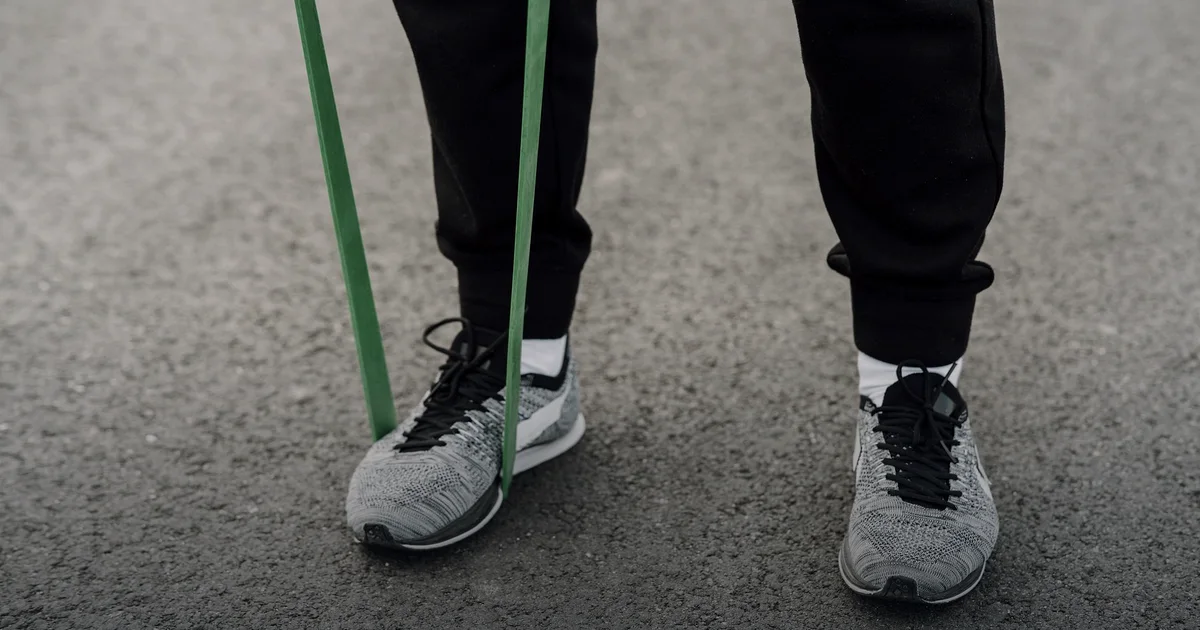
Picture this: your knee still isn't ready for the barbell after an injury, your running volume is slashed, and your muscles are visibly melting away. It's a familiar situation for anyone who's been sidelined for even a couple of weeks. And this is where a method comes into play that looks almost like a cheat code: you strap a cuff onto your thigh, pick up a laughably light weight — and get a response comparable to heavy strength work. It's called blood flow restriction training (BFR), or occlusion training.
How it works
The idea is simple. A pneumatic cuff is placed on the upper part of the working limb, and it partially restricts the arterial inflow and venous outflow of blood. Blood pools in the muscle, local hypoxia develops — a shortage of oxygen — and metabolic byproducts build up quickly. This metabolic stress is the main working tool.
Under normal conditions, a muscle recruits its fast (strong) fibers only under a serious load. With BFR, the body is forced to recruit them even with a light weight — the slow fibers simply run out of resources in the acidified environment. On top of that, anabolic signaling kicks in. The result: gains in strength and muscle mass at a load of just 20–40% of your one-rep max (1RM) — meaning minimal stress on the joints, ligaments, and tendons.
What the research shows
The most recent summary is a 2025 systematic review and meta-analysis (20 studies, 407 endurance athletes). The numbers are cautiously optimistic:
- VO2max — a moderate effect (magnitude 0,465; p < 0,001);
- endurance performance — a moderate effect (0,693);
- maximal strength — a large effect (1,022);
- aerobic power — a small but significant effect (0,315).
Some important caveats. First, not all of the studies produced a gain in VO2max — in some of them the difference from ordinary training was minimal. Second, the best result came when BFR was added to usual training rather than replacing normal work. And third, the authors are honest about the limitations: nearly all the studies involved mostly men, participant "blinding" was weak, and lactate threshold and running economy were rarely studied. So BFR is a working tool, not a magic pill.
Where it's useful for a runner
The main niche is not chasing records at all, but situations where heavy loading is off-limits or unnecessary:
- Rehabilitation and return after injury. When a joint or tendon can't tolerate a heavy load, BFR lets you maintain muscle strength and mass with gentle loads. This is, in essence, the flagship application of the method.
- Offloading the joints. Fewer kilograms on the bar means less compression on the knees and ankles.
- Maintaining muscle during an injury layoff or when running volume drops — for example, in the off-season or at the height of the competitive period, when there are no resources left for heavy strength work.
A typical protocol (a reference point, not a prescription): a low weight of about 20–30% of 1RM, a scheme of 30-15-15-15 reps with short rest breaks, moderate cuff pressure in the range of 40–80% of full occlusion. But all of this works only with properly calibrated cuffs, and ideally under the supervision of a specialist who will set the pressure for your limb.
Safety and contraindications
Here begins the serious part, which you cannot skim past.
The main myth: "cinch your leg with a belt or an elastic bandage and you can build muscle." That's dangerous do-it-yourself improvisation. An ordinary tourniquet gives no control over pressure: too loose and there's no effect, too tight and you completely block arterial blood flow. A calibrated cuff doses the pressure as a percentage of individual occlusion; a belt and a bandage do not.
BFR is contraindicated or requires a doctor's direct approval in cases of:
- cardiovascular disease;
- thrombosis or a history of a tendency toward clot formation;
- pronounced varicose veins;
- uncontrolled hypertension;
- pregnancy.
Disclaimer. This article is educational material, not an individual recommendation. Before trying BFR, consult a doctor or a specialized professional and use only certified, calibrated cuffs. Don't improvise with tourniquets and bandages.
The bottom line
- BFR is training with partial blood flow restriction: a cuff + a light weight (20–40% of 1RM) deliver a response close to heavy loads, thanks to metabolic stress and the recruitment of fast fibers.
- The 2025 meta-analysis (20 studies, 407 athletes) showed a moderate gain in VO2max and performance and a large gain in strength — but the effect is more consistent as a supplement to regular training.
- The real niche for a runner is rehabilitation, return after injury, offloading the joints, and maintaining muscle when volume is cut.
- Protocol reference point: ~20–30% of 1RM, a 30-15-15-15 scheme, pressure of ~40–80% of occlusion.
- Only calibrated cuffs and, ideally, the supervision of a specialist; no tourniquets or bandages.
- The contraindications are serious: cardiovascular disease, thrombosis, varicose veins, hypertension, pregnancy.
Source: Zhang Z., Gao X., Gao L. Effects of blood flow restriction training on aerobic capacity and performance in endurance athletes: a systematic review and meta-analysis. BMC Sports Science, Medicine and Rehabilitation, 2025. DOI: 10.1186/s13102-025-01194-3 — https://pmc.ncbi.nlm.nih.gov/articles/PMC12217518/